TikTok's algorithm uses multiple location signals to decide who sees your content. But not all signals are created equal. If you're a creator trying to reach US audiences, understanding how these signals are weighted — and which ones you can actually control — is the difference between your content reaching Americans or staying locked in your local market.
This post goes deeper than the basics. If you need a primer on what each signal is, start with how TikTok determines your location. Here, we'll focus on how the algorithm actually weighs and combines these signals for content distribution decisions.
The Algorithm's Location Pipeline
When you post a video on TikTok, the algorithm runs through a location assessment before deciding which audiences to show it to. This happens in milliseconds, and it works roughly like this:
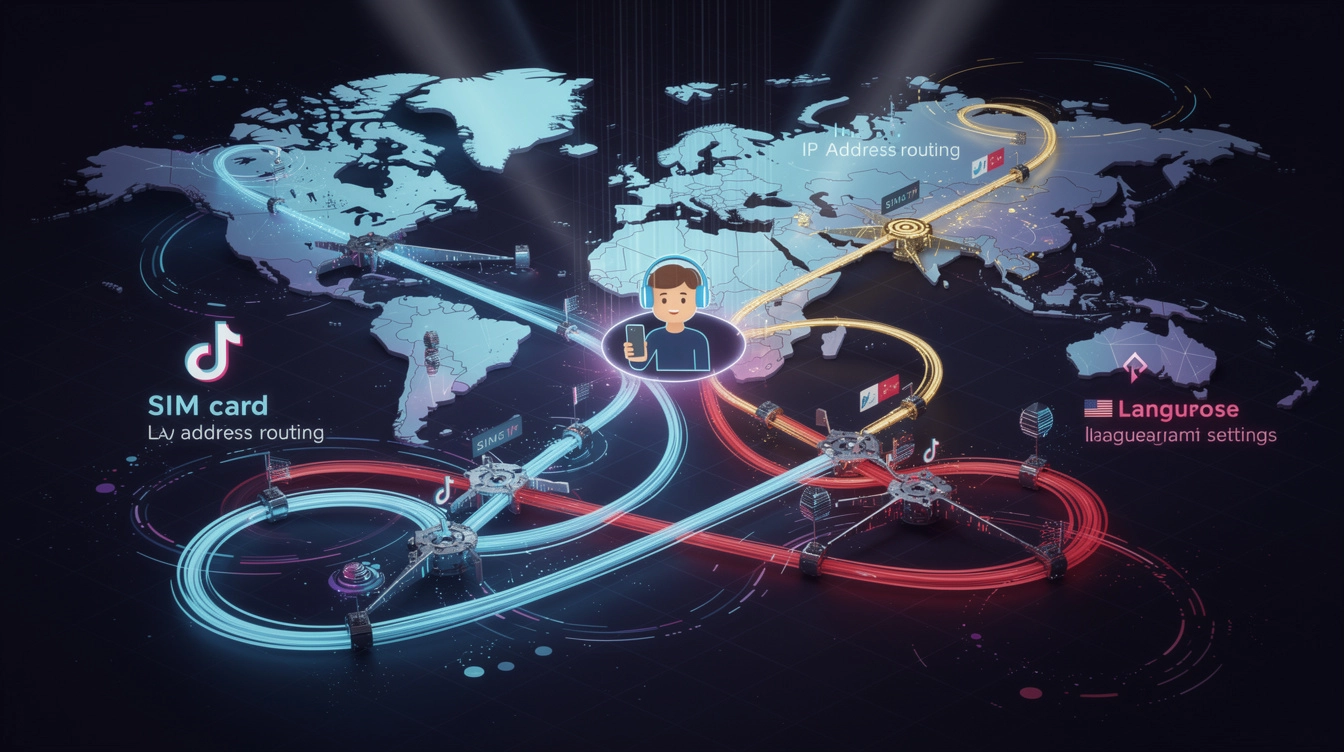
Step 1: IP Check — TikTok resolves your current IP address and maps it to a geographic region. This is the first and fastest check. If your IP is from Brazil, your content enters the Brazilian distribution pool.
Step 2: Signal Cross-Reference — TikTok checks your SIM card MCC, device region settings, and cell tower data against your IP. If all signals agree (everything points to Brazil), TikTok has high confidence in your location.
Step 3: Contradiction Detection — If signals disagree (US IP but Brazilian cell towers), TikTok flags this and may weight the more reliable signals higher. This is where consumer VPN users get caught — TikTok sees a US IP paired with non-US device signals and recognizes the inconsistency.
Step 4: History Overlay — TikTok factors in your account's location history. A sudden jump from Indonesia to the US raises different flags than a consistent US location over weeks.
Step 5: Distribution Decision — Based on all signals weighted together, TikTok places your content in a geographic distribution pool. Your initial audience comes from this pool.
Signal Weighting in Practice
Based on observed behavior from creators across different regions in 2026, here's how the signals stack up:
IP Address: ~50-60% Weight
Your IP address is the dominant signal. It's the hardest to fake convincingly (from TikTok's perspective) and the most reliable geographic indicator. When your IP says US, TikTok's first instinct is to distribute your content to US audiences.
However, the type of IP matters enormously:
- Residential IP (from a regular ISP) — highest trust, full distribution weight
- Dedicated/low-density datacenter IP — high trust, near-full weight. This is what VPN To US provides — clean IPs shared by a maximum of 100 users
- Shared consumer VPN IP — low trust. TikTok maintains databases of known VPN IP ranges used by NordVPN, ExpressVPN, and similar services. These IPs get deprioritized or flagged
SIM Card MCC: ~15-20% Weight
The SIM card's mobile country code is a meaningful secondary signal. TikTok reads it as a semi-permanent indicator — most people don't swap SIM cards frequently. When your SIM matches your IP (both US), it reinforces the location signal.
When they contradict (US SIM, Brazilian IP), TikTok typically defers to the IP for distribution purposes but notes the contradiction. This is why the SIM card trick alone doesn't reliably shift your audience — it's fighting against a stronger signal.
Cell Towers: ~10-15% Weight (Verification)
Cell tower connections serve primarily as a verification signal rather than a distribution driver. TikTok uses cell tower data to detect impossibilities: if your IP says Los Angeles but your phone is pinging towers in Jakarta, something is obviously off.
This signal is most relevant for contradiction detection, not for direct distribution decisions. A VPN user in Indonesia will still ping Indonesian towers, but if the VPN IP is clean and dedicated (not a known VPN range), the cell tower contradiction alone typically isn't enough to override the IP signal.
Account History: ~10-15% Weight (Cumulative)
Account history is a slow-building signal that gains weight over time. TikTok tracks:
- Where your account was created
- IP addresses used over the past 30-90 days
- Patterns of location changes
- Duration spent at each location
Fresh accounts have less history, so they're more responsive to current signals. Established accounts with months of activity from one region will take longer to shift — typically 1-2 weeks of consistent behavior from a new location.
Device Settings: ~5% Weight
Language, timezone, and region settings on your device are the weakest signals. They're trivially easy to change and TikTok knows it. They serve as tie-breakers when other signals are ambiguous, but they rarely drive distribution decisions on their own.
Break out of your local algorithm
Get a dedicated US IP that TikTok and Instagram actually trust. Setup takes 60 seconds.
See Plans from $5/moThe Consistency Factor
Beyond raw signal weighting, TikTok values signal consistency highly. An account where all signals point to the same location gets the strongest distribution in that region. Contradictions reduce confidence and can trigger fallback behavior (defaulting to the IP address or, in extreme cases, restricting distribution until signals stabilize).
This is why the most effective strategy for creators is to make the strongest signal (IP) consistent and clean:
- Use the same dedicated US IP every session — VPN To US provides this
- Always connect before opening TikTok
- Don't disconnect and reconnect mid-session
- Let account history build naturally over 1-2 weeks
You don't need to fake every signal. You need the dominant signal to be correct and consistent.
Looking for the simplest way to reach US audiences? VPN To US gives you a dedicated US IP in 60 seconds. See plans
Practical Takeaways for Creators
If you can only change one thing: Change your IP. It carries the most weight and VPN To US makes this straightforward — a dedicated, low-density US IP that TikTok treats as a legitimate connection. Plans start at $5/month.
If you want to maximize signals: Combine a dedicated US IP with English (US) device settings and English content. This covers the top-weight signal plus supporting signals.
Don't bother with: Changing your SIM card alone (secondary signal fighting against a primary one), or using consumer VPNs (blacklisted IPs that TikTok actively flags).
For a complete picture of how your location affects which audiences see your content, read how location affects For You Page distribution. If you're comparing methods for changing your location signal, see our SIM card vs VPN comparison.